
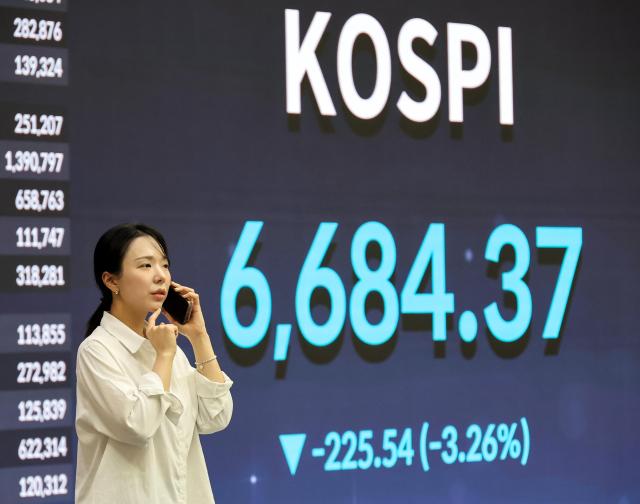
The benchmark KOSPI closed at 6,625.93, down 2.62 percent from the previous session. The index opened slightly higher at 6,808.68 but reversed course as selling accelerated through the afternoon.
Foreign investors sold a net 1.99 trillion won ($1.49 billion) of KOSPI shares, while institutions unloaded about 1.67 trillion won. Retail investors bought a net 2.90 trillion won, but their purchases failed to offset the combined selling pressure. Decliners outnumbered advancers 625 to 252.
The decline came despite Samsung Electronics' stronger-than-expected third-quarter earnings guidance, with operating profit surging 782.5 percent from a year earlier to a record 107.4 trillion won on strong demand for artificial intelligence (AI) memory chips, while revenue jumped 126.6 percent to 195 trillion won. The stock extended its morning losses to close 2.42 percent lower at 262,000 won.
Rival SK hynix also reversed its early gains, falling 2.44 percent to finish at 1,681,000 won. It had risen about 1.7 percent in morning trading before joining the broader chip selloff.
Other major technology shares followed the decline. Samsung Electro-Mechanics, a supplier of electronic components, dropped 3.62 percent to 1,546,000 won, while SK Square, the investment holding company and largest shareholder of SK hynix, plunged 8.06 percent to 1,050,000 won.
The selling extended beyond the chip sector as investors faced mounting pressure from higher U.S. Treasury yields and renewed concerns over global energy prices.
The U.S. 10-year Treasury yield hovered around 5.33 percent Thursday afternoon after briefly climbing above 5.36 percent the previous day, its highest level since 2002, adding to concerns that borrowing costs could remain high for longer.
Short-term trading factors also raised concerns about additional selling in Samsung shares. Ahead of the company's earnings announcement, Goldman Sachs had warned that semiconductor exchange-traded fund (ETF) rebalancing could trigger share sales. Options expiration could also increase market volatility, while the winding down of Samsung's share buyback program could weaken buying demand.
The decline was not limited to technology shares, with automakers, financial companies and biotechnology stocks also retreating.
Hyundai Motor dropped 3.42 percent to 324,500 won, while financial shares also declined. KB Financial Group fell 3.38 percent to 162,800 won and Samsung Life Insurance slipped 4.27 percent to 269,000 won.
Samsung Biologics, a major contract drug manufacturer, lost 4.54 percent to 1,219,000 won.
Battery shares offered a rare bright spot among large-cap stocks. LG Energy Solution rose 2.56 percent to close at 401,000 won after reporting stronger-than-expected preliminary third-quarter results.
The battery maker estimated operating profit at 756 billion won, up 25.7 percent from a year earlier, while revenue increased 59 percent to about 9.64 trillion won, a quarterly record.
The results were supported by increased shipments of energy storage systems (ESS) to North America and stronger sales of EV batteries in Europe, despite a broader slowdown in electric vehicle demand.
The KOSDAQ also finished lower, though its losses were more limited as some semiconductor equipment and component makers advanced despite declines in major memory chipmakers.
The junior index closed at 892.27, down 0.69 percent from the previous session. Foreign investors bought a net 60.0 billion won and retail investors purchased 50.3 billion won, while institutions sold 106.5 billion won.
Among the gainers, Jusung Engineering, a manufacturer of semiconductor deposition equipment, surged 8.08 percent to 267,500 won. Its equipment is used to deposit thin layers of materials onto silicon wafers during chip production.
Wonik IPS, which supplies semiconductor manufacturing equipment, also gained 1.98 percent to 133,700 won, while LEENO Industrial, a producer of semiconductor test sockets and probes, advanced 3.17 percent to 87,900 won.
Simmtech, a manufacturer of semiconductor package substrates and memory module circuit boards, rose 1.41 percent to 172,800 won.
Battery-related stocks also attracted selective buying. EcoPro BM, a producer of cathode materials used in rechargeable batteries, climbed 3.45 percent to 128,800 won, while its parent company EcoPro finished unchanged at 91,900 won.
The gains were offset by weakness in biotechnology and robotics shares.
Alteogen, a biotechnology company developing drug-delivery technologies for biologic medicines, dropped 6.23 percent to 241,000 won.
Rainbow Robotics, a developer of industrial and collaborative robots, also fell 4.03 percent to 429,000 won, while biotech company Peptron plunged 29.94 percent.
In currency trading, the Korean won was little changed at 1,340.7 per dollar, compared with 1,340.4 at the previous close.
Meanwhile, the Korea Exchange (KRX) said Wednesday it would suspend further delisting procedures for companies that fail to meet minimum market capitalization requirements, following a court ruling that blocked the delisting of two companies. The exchange said the affected stocks would remain under administrative supervision.
The market's decline extended a losing streak for the KOSPI, which had already fallen nearly 2 percent Wednesday as foreign investors sold heavily ahead of Samsung's earnings announcement.
Despite the record profit guidance, investors remained cautious about the sustainability of the AI-driven semiconductor boom and the impact of high global interest rates on equity valuations.
Samsung is scheduled to release its detailed third-quarter earnings, including business division results, on Oct. 29.
Across the region, major Asian stock markets also traded lower. Japan's Nikkei 225 fell 1.42 percent to 69,042.11, while China's Shanghai Composite declined 0.79 percent to 3,811.90. Hong Kong's Hang Seng Index dropped 1.48 percent to 23,772.25.

Copyright ⓒ Aju Press All rights reserved.
