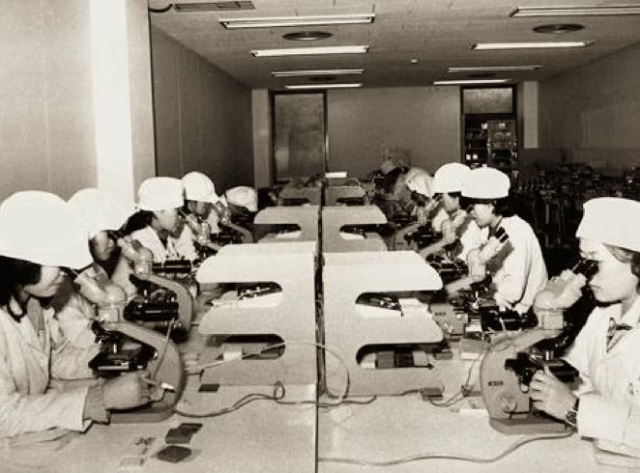
SEOUL, October 08 (AJP) - It all began humbly in 1975, with women in protective head coverings bent over workstations assembling integrated circuits for LED wristwatches.
More than half a century later, Samsung Electronics has become the world’s largest vendor of memory chips powering everything from smartphones to sprawling AI data centers and turning factory output into profits on a scale unprecedented among the world's technology companies.
The scale of that transformation is captured in its latest quarterly estimates.
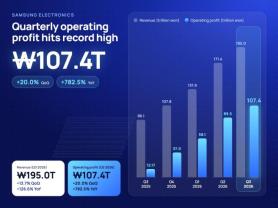
Samsung expects to have earned 107.4 trillion won ($80.2 billion) in operating profit on revenue of 195 trillion won in the three months ended September, with semiconductors accounting for virtually all its earnings.
Samsung’s quarterly global revenue of about $145.6 billion would be equivalent to nearly half of the country’s $318.4 billion in third-quarter exports and almost matched its $148 billion in semiconductor shipments.
Operating profit alone exceeded half the value of those chip exports.
The comparison illustrates the scale of Samsung’s business rather than its direct share of Korean exports, since its consolidated revenue includes domestic sales and production overseas.
The memory boom nevertheless came with a trade-off, eroding the hardware businesses that made Samsung a household name.
Soaring chip prices have enriched its semiconductor operations while raising production costs for Galaxy smartphones, televisions and home appliances. Within the same company, a component supplier’s windfall has become a finished-goods manufacturer’s burden.
The breakdown by business is due with the full earnings release on Oct. 29, but analysts’ estimates suggest the headline feat conceals a widening divide.
The semiconductor-focused Device Solutions, or DS, division is estimated to have generated roughly 108 trillion won to 110 trillion won in operating profit during the quarter, potentially exceeding Samsung’s consolidated earnings. That would mean its chip operations earned enough to absorb net losses across the rest of the company and still deliver a record result.
The Device eXperience, or DX, division, which oversees smartphones, televisions and home appliances, is estimated to have suffered an operating loss of around 1.5 trillion won.
IBK Investment & Securities projected a 1.1 trillion won operating loss for the mobile and networks businesses. Yuanta Securities separately estimated losses of 900 billion won for mobile and networks and 200 billion won for televisions and home appliances.
The imbalance was already pronounced in the second quarter, when DS contributed 89.2 trillion won of Samsung’s 89.5 trillion won in consolidated operating profit, or about 99.7 percent. Mobile and networks lost 700 billion won, while televisions and home appliances also slipped into the red.
The latest estimates suggest that Samsung’s dependence on memory has deepened even as its overall earnings continue to climb.
At the heart of the divergence is the position of its businesses on opposite sides of the memory supply chain.
For Samsung’s chip operations, demand for high-bandwidth memory used in AI processors, conventional DRAM and NAND flash storage has lifted selling prices and margins. AI data centers are absorbing growing volumes of memory, while the shift toward advanced AI products is constraining production capacity available for conventional chips used in phones and computers.

For the smartphone business, those same chips represent an increasingly expensive input. Rising DRAM and NAND prices push up the cost of making Galaxy devices, leaving the business to raise retail prices, find savings elsewhere or sell a greater proportion of premium models.
Each option has limits. Consumers may resist further price increases, while strong sales of flagship and foldable phones do not necessarily translate into stronger earnings when component costs rise faster than selling prices.
Televisions and home appliances face similar pressure from higher costs, compounded by subdued consumer demand and intense competition.
Even within semiconductors, the gains are uneven.
Samsung’s non-memory operations, including its foundry business making chips for outside customers and its System LSI chip-design unit, are estimated to have remained in the red. Industry estimates put their combined operating loss at around 1 trillion won, despite signs of improving foundry utilization.
Memory is therefore carrying more than Samsung’s consumer electronics businesses. It is also absorbing losses within the semiconductor division itself.
The result is a company with a vast product portfolio but an increasingly concentrated source of profit. Businesses that once helped Samsung withstand swings in the memory cycle are now relying on that cycle’s exceptional strength.
The full results later this month will reveal how much the memory boom earned Samsung, and how much of that windfall was needed to cover losses elsewhere in the company.

Copyright ⓒ Aju Press All rights reserved.