SEOUL, November 09 (AJP) - The foreign flight from Korean chip stocks over fears of slower U.S. data center construction need not spell the end of the AI fairy tale since power constraints unsettling investors could instead reward Korean chipmakers’ years of investment in energy efficiency, according to a semiconductor expert.
Investors risk equating fewer new data centers with fewer memory orders, overlooking demand for upgrades at existing facilities, said Lee Jong-hwan, a professor of system semiconductor engineering at Sangmyung University.
If electricity costs, strained power grids and environmental concerns are driving resistance to new facilities, chips that deliver more computing performance per watt could become part of the solution. That could give Samsung Electronics and SK hynix opportunities to differentiate themselves from Chinese manufacturers and U.S. rival Micron Technology.
“South Korea should look beyond the scale of U.S. data center construction and examine where AI infrastructure investment is shifting and what semiconductor technologies it requires,” Lee told AJP.
“Even if data center construction is delayed, demand for equipment upgrades at existing facilities could continue,” he added. That distinction has been overshadowed by the market’s reaction to the U.S. midterm elections.
Democrats won control of both chambers of Congress on November 3 and captured governorships in major data center markets, including Texas and Georgia. The results heightened concerns that political opposition to rising electricity bills and pressure on local infrastructure could delay new AI projects.
The KOSPI plunged 6.02 percent to 5,059.69 on Friday. Samsung Electronics fell 6.35 percent and SK hynix tumbled 10.44 percent as investors reassessed the outlook for AI spending.
The immediate concern is that delayed construction could push back orders for high-bandwidth memory (HBM), a critical component of AI accelerators, and server DRAM. But the longer-term implications depend on how operators respond to limits on electricity supply.
Companies unable to secure more power could have stronger incentives to replace existing equipment with systems that perform more work within the same electricity budget. Investment could shift toward efficiency even as some expansion plans slow.
For chipmakers, that would place greater weight on performance per watt, heat management and the way processors and memory work together.
“Technology development needs to focus not only on HBM performance, but also on performance per watt, heat generation and packaging efficiency,” Lee said.
“As power constraints at data centers intensify, energy efficiency at the system level will become an increasingly important competitive factor.”
Samsung and SK hynix have spent years developing technologies that increase memory speed and capacity while managing power consumption and heat. Both now highlight efficiency improvements alongside the performance gains of their latest HBM products.
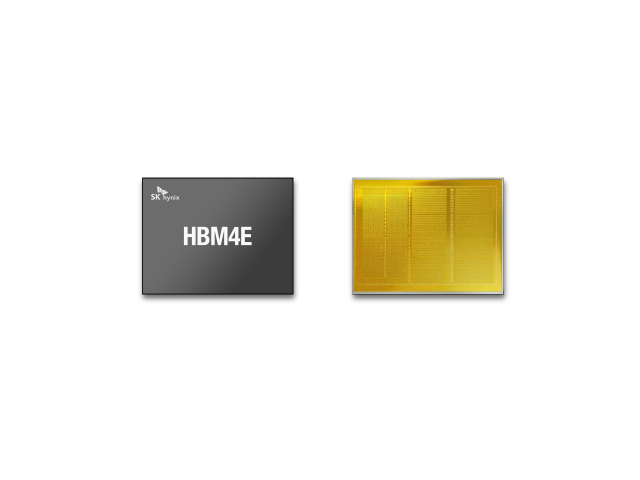
SK hynix said its HBM4 doubles memory bandwidth while improving power efficiency by 40 percent over the previous generation. Its HBM4E offers a further improvement of more than 20 percent.
Samsung said its HBM4 improves power efficiency by about 40 percent over HBM3E through low-voltage through-silicon via technology — vertical connections between stacked chips — and optimized power distribution. Its HBM4E delivers a further 16 percent improvement over HBM4.
Those figures compare each company’s products with its own earlier generations. They do not establish which manufacturer has the most efficient chips, nor do they translate into equivalent reductions in a data center’s total electricity consumption.
They nevertheless illustrate how advanced memory competition is expanding beyond bandwidth and capacity to encompass the power required to deliver that performance.
“Low-power technology has always been important in semiconductors,” Lee said. “If Korean companies can turn that capability into a point of differentiation against Chinese rivals and Micron, they could turn this challenge into an opportunity.”
For Samsung, the opportunity could extend beyond memory to its foundry business, which manufactures chips designed by other companies.
Major technology companies are developing custom AI accelerators tailored to their workloads. Efforts to perform specific tasks more efficiently could create additional demand for advanced manufacturing processes and low-power designs.
Lee said Samsung’s memory and manufacturing capabilities could support high-performance, low-power AI chips, including neural processing units (NPUs).
Samsung already combines its sixth-generation 10-nanometer-class DRAM with a 4-nanometer logic base die in HBM4, bringing its memory and foundry technologies together in one product.
A Samsung official cautioned that demand for advanced manufacturing depends on several considerations.
“Power efficiency is certainly an important factor, but it is not the only one,” the official said. “Chip size, integration density and performance also matter.”
The official added that demand for more advanced chips could support leading-edge processes, although tighter data center power constraints could not yet be directly linked to additional foundry orders.
While those investment priorities evolve, existing long-term supply agreements could help cushion Korean memory makers against an immediate demand shock.
SK hynix said at its October 28 earnings briefing that it had signed long-term agreements (LTAs) with 14 major customers, including global cloud service providers. The agreements secured volumes equivalent to more than half its production capacity for 2027 and 2028.
An SK hynix official said quantities and delivery schedules could be adjusted within agreed limits, but the contracts provided a degree of sales stability.
“These agreements are based on securing a certain volume of orders,” the official told AJP. “There are safeguards in place to protect those commitments.”
The official indicated that no significant changes to existing supply arrangements or delivery schedules had emerged following the election.
A Samsung official also said an immediate decline in memory demand appeared unlikely, citing the time needed for potential restrictions to affect investment and the growing share of supply covered by long-term contracts.
“It is probably too early for these developments to have a meaningful impact,” the official said. “With more supply arranged through LTAs, a short-term issue like this is unlikely to cause an immediate drop in demand or a major hit to revenue.”
Those agreements do not guarantee that all volumes and prices will remain unchanged. A prolonged slowdown in AI infrastructure investment could weigh on future orders, contract negotiations and production plans.
Nor would a shift toward more efficient chips necessarily offset every order lost to delayed construction. The outcome would depend on the scale of investment, the pace of equipment replacement and the competitiveness of each supplier’s products.
But treating resistance to power-hungry data centers as a straightforward threat to Korean semiconductors overlooks what customers may need next. Operators facing electricity limits still have reason to seek more computing capacity from the facilities they already run.
Samsung and SK hynix have invested in the low-power technologies that could help deliver it. Their next test is to turn those capabilities into measurable gains for customers — and new orders.

Copyright ⓒ Aju Press All rights reserved.