
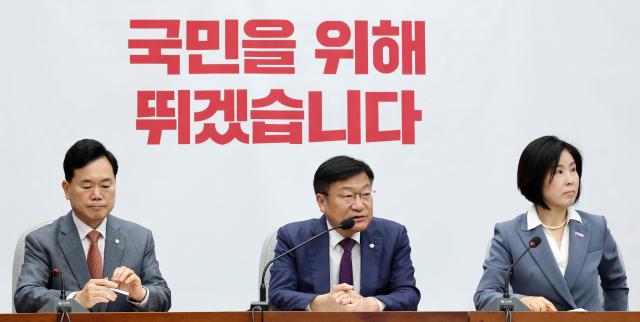
Jung Jeom-sik, the leader of the People Power Party, emphasized on June 16 that the decision to file election appeals was made with the priority of restoring voter rights over the party's political interests.
During a parliamentary countermeasure meeting, he referred to the decision made the previous day by the Supreme Council regarding election appeals in six regions, including Seoul. Jung characterized the incidents, such as a shortage of ballots, as a 'June 3 infringement of voter rights' and stated, "It is essential to closely examine how the actions that infringed on voter rights affected the election results at polling places where such violations occurred, in line with the principles of fair elections."
He added, "Equally important as the election appeals is the need for a thorough investigation into the facts. The National Assembly must swiftly launch a special committee for a national investigation and ensure a fair and impartial special prosecutor's investigation to thoroughly identify the causes and responsibilities behind the June 3 infringement of voter rights."
Jung pointed out, "To protect the integrity of even a single ballot, what is urgent is not a special prosecutor for the cancellation of charges, but a special prosecutor for the election commission."
Kim Seung-soo, the deputy leader of parliamentary operations, also remarked that if current power holders or high-ranking government officials become subjects of investigation, it would be difficult for existing investigative agencies to conduct inquiries without political pressure. He stressed that to quickly resolve suspicions amid growing public outrage over the flawed election, a special prosecutor must be appointed to conduct an unrestrained investigation.
Meanwhile, Jung urged the government to completely overhaul its real estate policy. He noted that the average housing sale price in Seoul has surpassed 1 billion won for the first time, asserting, "This is evidence that the real estate policy of the Lee Jae-myung administration is fundamentally flawed. If the government does not fully change its real estate policy now, it will not be able to prevent the polarization between Seoul and the provinces."
During a parliamentary countermeasure meeting, he referred to the decision made the previous day by the Supreme Council regarding election appeals in six regions, including Seoul. Jung characterized the incidents, such as a shortage of ballots, as a 'June 3 infringement of voter rights' and stated, "It is essential to closely examine how the actions that infringed on voter rights affected the election results at polling places where such violations occurred, in line with the principles of fair elections."
He added, "Equally important as the election appeals is the need for a thorough investigation into the facts. The National Assembly must swiftly launch a special committee for a national investigation and ensure a fair and impartial special prosecutor's investigation to thoroughly identify the causes and responsibilities behind the June 3 infringement of voter rights."
Jung pointed out, "To protect the integrity of even a single ballot, what is urgent is not a special prosecutor for the cancellation of charges, but a special prosecutor for the election commission."
Kim Seung-soo, the deputy leader of parliamentary operations, also remarked that if current power holders or high-ranking government officials become subjects of investigation, it would be difficult for existing investigative agencies to conduct inquiries without political pressure. He stressed that to quickly resolve suspicions amid growing public outrage over the flawed election, a special prosecutor must be appointed to conduct an unrestrained investigation.
Meanwhile, Jung urged the government to completely overhaul its real estate policy. He noted that the average housing sale price in Seoul has surpassed 1 billion won for the first time, asserting, "This is evidence that the real estate policy of the Lee Jae-myung administration is fundamentally flawed. If the government does not fully change its real estate policy now, it will not be able to prevent the polarization between Seoul and the provinces."
* This article has been translated by AI.
Copyright ⓒ Aju Press All rights reserved.