
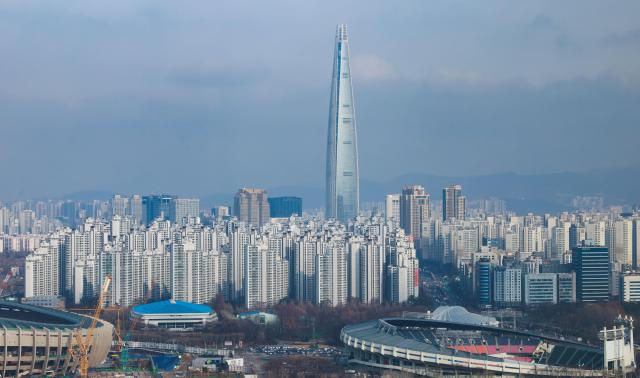
Consumer sentiment in the real estate market is rapidly recovering, particularly in the capital region. While the national index remains stable, the capital area has entered an upward phase, highlighting a significant divergence from non-capital regions.
According to the "May 2026 Real Estate Market Consumer Sentiment Survey" released by the Korea Research Institute for Human Settlements on June 16, the national housing market sentiment index rose by 3.1 points to 114.9 compared to the previous month. The capital region's index increased by 4.5 points to 122.1, maintaining its upward trend, while the non-capital region saw a modest increase of 1.2 points to 106.3. The gap in housing market sentiment between the two areas widened to 15.8 points.
Overall consumer sentiment in the real estate market followed a similar trend. The national real estate market sentiment index rose by 2.7 points to 111.4, remaining stable. However, the capital region's index climbed by 3.9 points to 118.4, transitioning into an upward phase. In contrast, the non-capital region's index increased by only 0.9 points to 103.3, expanding the gap with the capital region to 15.1 points.
In the housing transaction market, the concentration in the capital region was even more pronounced. The national housing transaction sentiment index rose by 4.7 points to 116.7, marking a shift to an upward phase. The capital region's index surged by 6.1 points to 125.2, while Seoul's index skyrocketed by 10.7 points to 135.6. Notably, Seoul's housing transaction sentiment surpassed the critical threshold of 135, indicating a stronger recovery in buyer sentiment.
In a regional survey conducted in May regarding housing prices, 4.1% of respondents in Seoul indicated that prices had "increased significantly," while 51.3% said they had "somewhat increased." Overall, 55.4% of respondents reported a rise in prices. In comparison, the national average for price increases was only 27.4%, highlighting a more pronounced perception of rising prices in Seoul.
Regionally, the largest increase in housing transaction sentiment was observed in Gwangju, which rose by 13.9 points, followed by Seoul at 10.7 points and Jeju at 6.4 points. Conversely, Chungnam saw a decline of 5.0 points, and Busan dropped by 2.6 points. This suggests that the recovery in transaction sentiment is concentrated in Seoul and the capital region, rather than being evenly distributed across the country.
The gap between the capital and non-capital regions was also evident in the rental market. The national housing rental market sentiment index rose by 1.7 points to 113.2. The capital region's index increased by 3.0 points to 119.0, maintaining its upward trend, while Seoul's index rose by 4.8 points to 124.2. In contrast, the non-capital region's index only increased by 0.2 points to 106.3.
Rental supply concerns were particularly pronounced in Seoul. In a survey on rental housing trends, 65.8% of respondents reported that "there were many people looking to rent," while only 8.9% indicated that "there were many landlords looking to rent." In a separate survey on rental prices, 64.3% of respondents in Seoul noted that rental prices had increased, confirming both a demand advantage and a perception of rising prices.
In contrast, the land market exhibited a different trend. The national land market sentiment index fell by 1.9 points to 79.1, continuing its downward trajectory. Both the capital region and non-capital region remained in a declining phase, with indices of 85.0 and 76.2, respectively. While housing transaction and rental sentiment showed signs of recovery, the land market remains subdued.
An industry insider commented, "With the rapid recovery of transaction sentiment centered in Seoul and the accompanying rental supply concerns, major areas in the capital region may see a corresponding increase in transaction volume and price trends. However, the recovery strength in non-capital regions is weak, and the land market remains in a downward phase, suggesting that the temperature difference in the market will persist for the time being."
* This article has been translated by AI.
Copyright ⓒ Aju Press All rights reserved.