
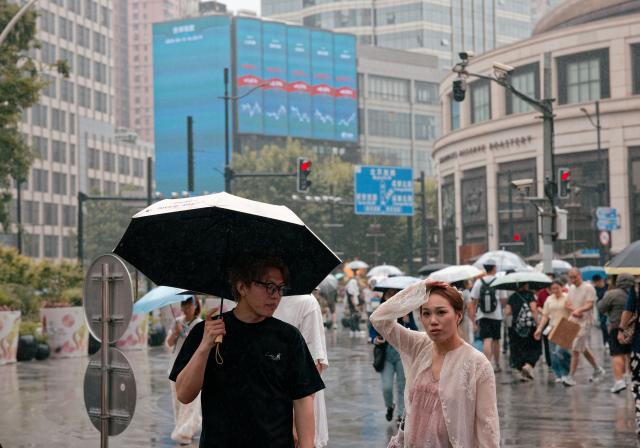
China's consumer spending has turned negative for the first time in three and a half years since the COVID-19 pandemic began, while investment has also declined for two consecutive months. Despite strong export performance, the domestic recession is deepening, increasing downward pressure on the Chinese economy.
According to the National Bureau of Statistics of China, retail sales in May fell by 0.6% year-on-year to 4.109 trillion yuan. This figure is below both the previous month's growth rate of 0.2% and Bloomberg's forecast of a 0.2% decline.
The last time China's consumer growth rate turned negative was in December 2022, shortly after the end of the zero-COVID policy, when infections surged (-1.8%). The recent Labor Day holiday in early May did little to boost domestic consumption.
In addition to consumption, fixed asset investment, one of China's three main growth engines alongside exports and consumption, also underperformed expectations. From January to May, fixed asset investment decreased by 4.1% compared to the same period last year, marking two consecutive months of decline following a 1.6% drop in April. This figure is worse than Bloomberg's forecast of a 2.6% decline. Notably, real estate development investment fell by 16.2% year-on-year, a larger drop than the 13.7% decrease recorded from January to April.
Despite the worsening consumption and investment indicators, production and employment showed relatively stable trends. Industrial production, which reflects corporate activity, increased by 4.5% year-on-year in May, slightly improving from April's 4.1% and surpassing Bloomberg's forecast of 4.3%. The urban unemployment rate in May also decreased slightly to 5.1%, down from 5.2% in April.
The National Bureau of Statistics stated that while the economy is showing an overall stable trend, the external environment has become more complex and uncertain. Domestically, a structural imbalance where supply exceeds demand is becoming more pronounced, putting significant operational pressure on some companies.
Indeed, amid geopolitical instability in the Middle East, China's exports continue to grow at double-digit rates, driven by a global boom in artificial intelligence (AI) investment. However, the strong export performance has not translated into a recovery in domestic consumption, highlighting the structural imbalance in the economy.
Additionally, while the producer price index (PPI) rose significantly in May, marking the largest increase in nearly four years, the consumer price index (CPI) showed signs of stagnation. Reuters noted that the widening gap between PPI and CPI growth rates suggests that demand is not keeping pace with supply-side growth. Concerns have been raised that, in the slow recovery of domestic consumption, companies may struggle to pass on rising costs to product prices, potentially harming profitability.
Bloomberg pointed out that while manufacturing and exports are driving growth, domestic consumption remains sluggish due to the real estate crisis and a weak job market. They further warned that even if global logistics and energy markets stabilize due to easing tensions in Iran, the lack of support for domestic consumption could exacerbate downward pressure on the Chinese economy.
* This article has been translated by AI.
Copyright ⓒ Aju Press All rights reserved.