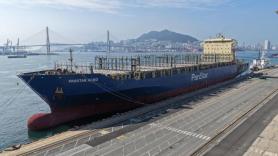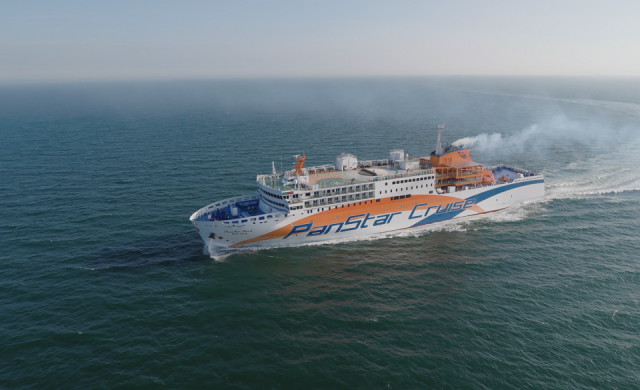
PanStar Group is keeping to its target of departing Busan for Rotterdam around Aug. 22, a source at the shipping and logistics group told AJP.
"There has been no change to our Aug. 22 departure target so far," the source said.
The confirmation provides greater clarity over the schedule after the Ministry of Oceans and Fisheries said earlier this week that it was considering a departure in either August or September but had not finalized a departure date.
PanStar is preparing to deploy the 2,758-TEU HMM Mombasa, which it purchased from South Korea's largest container carrier, HMM. The vessel will be renamed PanStar Acro.
Although the purchase agreement has been completed, the ship has yet to be physically delivered because HMM must first unload cargo from its final commercial voyage, the source said.
Once handed over, the vessel will enter a shipyard for its name change and modifications required for Arctic navigation. The work is expected to continue until shortly before departure.
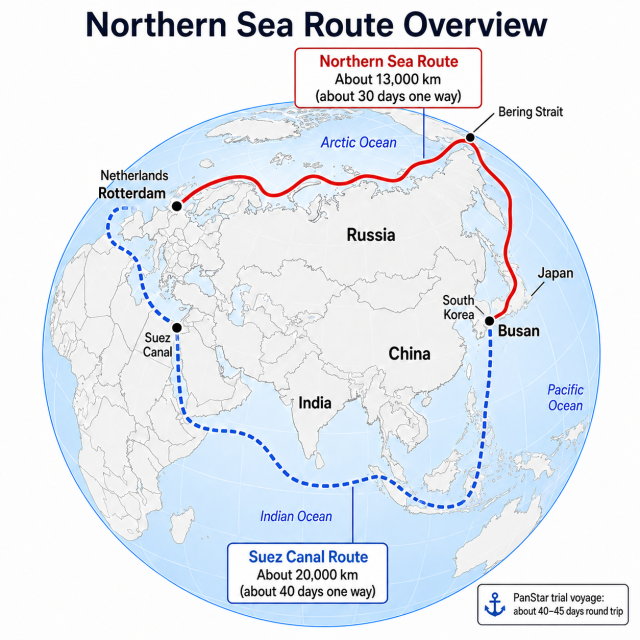
The round trip between Busan and Rotterdam is expected to take about 40 to 45 days, with the return voyage calling at Hamburg and Gdansk, Poland.
PanStar was the only company to apply for the government-backed trial despite Seoul's ambition to use the voyage as the first step toward a regular express shipping route between Northeast Asia and Europe.
The Korea Ocean Business Corp. and the Korea Shipowners' Association opened applications on April 27 and accepted bids through May 11. PanStar Line Dot Com, the sole applicant, was selected as the preliminary operator on May 15 after an evaluation committee review.
The source said PanStar had never intended to lead the project and believed it would ordinarily have been the domain of one of South Korea's major container carriers.
"We did not raise our hand because this was something we particularly wanted to do," the source said. "Considering the scale of the project, it would have made more sense for a larger shipping company to undertake it."
Instead, those carriers stayed away because of the commercial and geopolitical risks.
Most of the Northern Sea Route runs through waters administered by Russia. Ships may require Russian permits, navigation information, weather services and icebreaker assistance, raising concerns that related payments could conflict with Western sanctions.
Major carriers also face greater exposure because their vessels regularly call at U.S. ports and many of their largest customers are multinational companies with strict sanctions compliance requirements, the source said.
Environmental opposition has added another hurdle.
Nike and Ocean Conservancy launched the Arctic Corporate Shipping Pledge in 2019, under which consumer brands agree not to intentionally transport products through Arctic shipping routes. Signatories include H&M Group, Gap, Kering, Ralph Lauren, Puma and Inditex, while logistics companies such as DHL have also joined.
Several major container lines, including CMA CGM, Hapag-Lloyd and MSC, have adopted similar commitments. MSC most recently reaffirmed in September 2025 that it would avoid the Northern Sea Route, citing potential harm to the Arctic's fragile ecosystem, melting ice caps and remote communities.
"Given sanctions, international regulations and other constraints, it is difficult for major shipping lines to participate," the source said. "In the end, no carrier was willing to take it on."
The Korea Shipowners' Association subsequently approached PanStar.
According to the source, the association viewed the company as a practical candidate because it primarily serves Korea, China and Japan rather than the United States, has experience opening new maritime services and is headquartered in Busan, where the voyage will begin and end.
PanStar ultimately agreed after internal discussions.
"Our chairman decided that someone had to do it for the country," the source said. "Since nobody else was willing, we agreed to take it on even though it would be difficult."
Although the project is backed by the Ministry of Oceans and Fisheries, the Korea Ocean Business Corp. and the Korea Shipowners' Association, it receives no direct government budget.
Instead, the Korea Shipowners' Association will provide up to 4 billion won ($2.8 million) from an industry fund.
The money is also largely paid only after the voyage is completed rather than covering preparation costs in advance.
Under the arrangement, 3 billion won is tied to the successful completion of the voyage, while another 1 billion won will be paid if the round-trip carries at least 2,000 TEUs.
"There is no money directly provided by the government," the source said. "The support is settled afterward if we complete the Arctic voyage safely, and even the maximum amount is only 4 billion won."
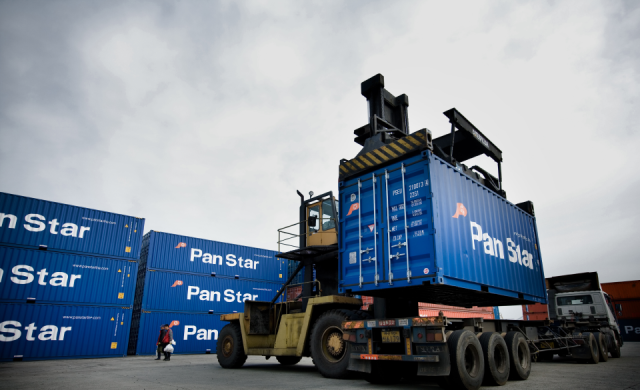
PanStar said it had secured or was discussing shipments of automobile parts, synthetic resins, used vehicles, food, liquid cargo, cosmetics and steel products. The company also said inquiries and bookings for transshipment cargo from Japan and China were increasing.
The company has not decided whether to hold a public departure ceremony or open the vessel to the media before sailing, pending discussions with the oceans ministry.
If successful, the voyage would shorten the traditional Busan-to-Rotterdam route via the Suez Canal by about 8,000 kilometers, or 36 percent.
Yet PanStar's experience also illustrates the gap between the Northern Sea Route's strategic promise and its commercial reality. While the Arctic passage offers a significantly shorter link between Northeast Asia and Europe, dependence on Russian-controlled waters, sanctions uncertainty, environmental opposition and still-limited cargo demand continue to keep the world's largest container lines on the sidelines.
AJP Takeaway:
- PanStar Group is preparing what would be South Korea's first container voyage through the Northern Sea Route, with a target departure from Busan around Aug. 22.
- The Russian Arctic route promises to shorten the Busan-Rotterdam voyage by about 8,000 kilometers, or 36 percent, compared with the traditional Suez Canal route.
- Larger global container lines declined to participate because of Russia-related sanctions risks, compliance concerns and environmental opposition from multinational cargo owners.
- PanStar became the sole operator of the government-backed trial after being approached by the Korea Shipowners' Association, with financial support paid largely only after the voyage is successfully completed.

Copyright ⓒ Aju Press All rights reserved.