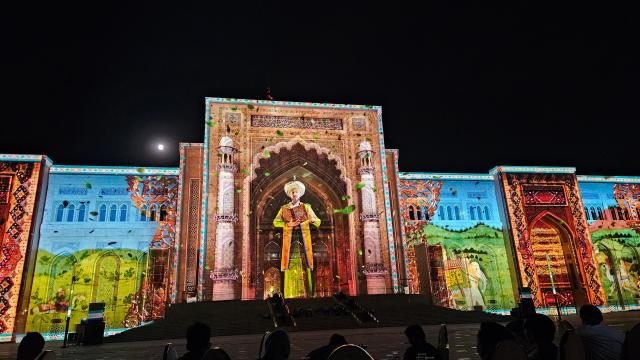
TASHKENT, August 26 (AJP) -For roughly 40 minutes Tuesday night, the massive façade of Uzbekistan's new Center for Islamic Civilization became a screen for a different telling of Islamic history.
Astronomers, physicians, thinkers and poets appeared across the building in light, animation and digital imagery as music accompanied a narrative tracing the contribution of scholars from present-day Uzbekistan and the wider Islamic world to science, medicine, literature and other fields.
The projection mapping show was followed by traditional Uzbek music and opera. The evening was more than an elaborate cultural performance staged for hundreds of foreign media executives, journalists, filmmakers and scholars visiting Tashkent. It distilled the ambition behind the center itself.
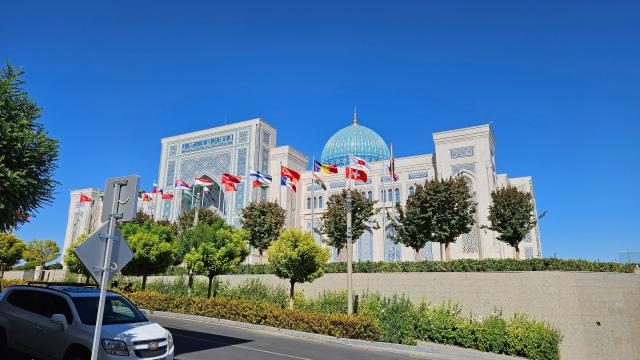
Uzbekistan is seeking to present Islamic civilization not primarily through religion or monuments, but through a history of science, learning and intellectual exchange — and to use the tools of modern information technology to make that history understandable to a global generation raised on screens.
Inside the same complex are ancient manuscripts and conventional museum collections alongside artificial intelligence avatars, immersive displays and a developing virtual-reality tour.
The Center for Islamic Civilization, built on nearly 10 hectares beside Tashkent's historic Hazrati Imam complex, officially opened on March 17. Its galleries stretch from pre-Islamic Central Asia through what Uzbekistan describes as its first and second renaissances and toward President Shavkat Mirziyoyev's vision of a new "Third Renaissance."
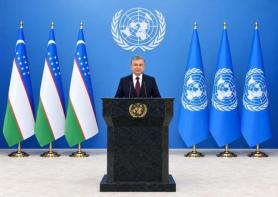
Mirziyoyev first presented the idea internationally at the United Nations General Assembly in September 2017, arguing that Islam should be associated with peace, human values and the pursuit of knowledge rather than violence and bloodshed. Construction began the following year.
Eight years later, the question for Uzbekistan is no longer simply how to preserve that heritage, but to draw global attention.
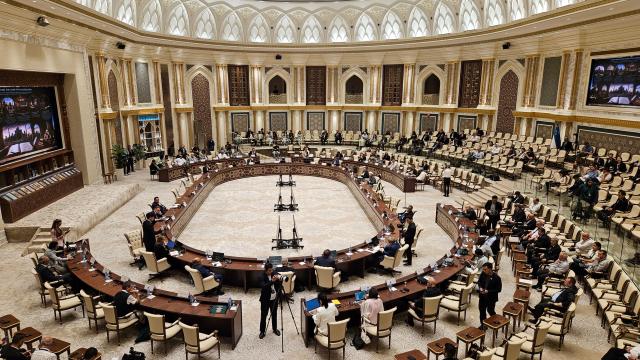
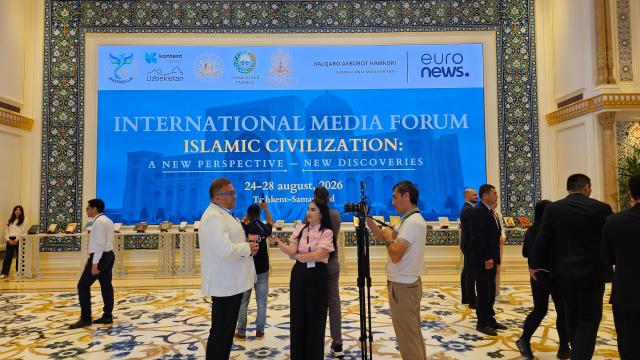
It is why the International Media Forum, "Islamic Civilization: A New Perspective — New Discoveries" was deliberately staged at the center by bringing in around 300 journalists, media executives, filmmakers, scholars and technology specialists from nearly 50 countries this week.
And seen from inside the center, rather than through a government statement or museum brochure, the strategy becomes easier to understand. The building is intended not just as a repository of objects but as a communications platform.
Imran Ahmad, regional representative for CNN International Commercial, told the forum that Uzbekistan did not lack stories. The difficulty was making those stories relevant to audiences elsewhere.
Ahmad recalled visiting the country about two decades ago and again five years ago, saying the speed of modernization and a new sense of energy were immediately visible.
Uzbekistan, he noted, occupied the heart of the ancient Silk Road and produced scholars who calculated the movement of the stars with extraordinary precision centuries ago.
The question is how that history travels beyond Uzbekistan.
Jahongir Ahmedov, first deputy culture minister and director of Uzbekistan's Cinematography Agency, said heritage should be something people can "see and hear and interact" with.
Digital content, he said, would be particularly important in introducing younger Uzbeks to the achievements of earlier generations and turning that knowledge into a source of national confidence.
The center provides a physical demonstration of what he meant. Visitors can move from manuscripts and historical exhibits into rooms where digital technologies attempt to reconstruct the people and ideas behind them. The same history can then be repackaged into films, books, immersive installations and online content.
For Uzbekistan, that increasingly means treating cultural heritage not as a collection of objects to be viewed behind glass, but as an experience.
The broader media forum has a similar ambition. Organizers say its central concept is to translate historical and spiritual heritage into the language of television, cinema, publishing, artificial intelligence and immersive museum technologies.
Discussions this week cover the contributions of Islamic civilization to mathematics, astronomy, medicine, philosophy, literature, architecture and art.
Ahmed Salim, founder of the British-based 1001 Inventions project, argued that doing so requires more than producing promotional material.
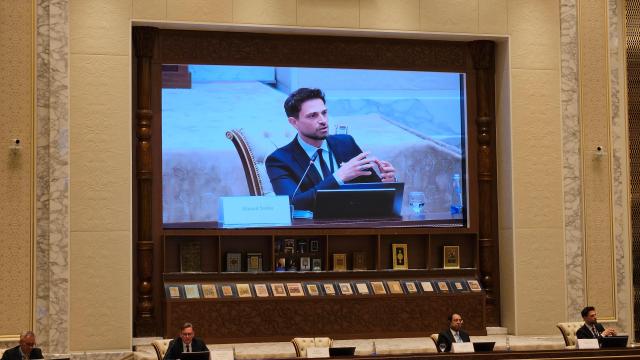
Salim said the conventional historical narrative he encountered growing up in Britain moved from ancient Greece and Rome to Europe's so-called Dark Ages and then to the Renaissance, Galileo and Newton.
That, he argued, presented an incomplete picture of human history.
While scientific development slowed in parts of Europe, major advances were taking place elsewhere, including in the lands of present-day Uzbekistan and the wider Islamic world. Leaving those chapters out, Salim said, could foster both an inferiority complex among people whose history was ignored and a superiority complex among those taught that civilization advanced primarily through the West.
Rediscovering those stories, he said, could produce not merely tolerance of other civilizations but "appreciation."
Salim also emphasized "transmedia storytelling" — taking one historical story and redeveloping it across films, museum exhibitions, books, digital platforms and educational content.
His organization has already been putting the idea into practice.
Academy Award-winning actor Ben Kingsley narrates "Whispers of Wisdom," a film series created for the Center for Islamic Civilization about scholars and intellectual pioneers from Uzbekistan and the wider region. The production brings together the 1001 Foundation, Uzbek production company Spectre Films and director Shokhrukh Rasulov.
Salim said one of his earlier productions on the history of science had reached an audience of more than 500 million people and continued to be shown in schools around the world — evidence, he argued, that historical content does not have to remain confined to museums or academic institutions.
Rasulov told participants he had had the "privilege" of working with Kingsley in London on the first season of "Whispers of Wisdom."
The series explores Uzbek scholars, historical figures and the legacies they left to the wider world. Rasulov said a second season was in preparation and that Benedict Cumberbatch, Ralph Fiennes, Liam Neeson, Mark Ruffalo and Antonio Banderas were among the actors being considered as its next host.
Participants returning to the media forum next year could see the result, he said.
Sergey Stanovkin, head of BBC Studios' commercial representation in Eurasia, approached the issue from the perspective of strategic communication.
Uzbekistan's cultural heritage, he said, has the potential to become a source of national "soft power" if it is communicated internationally in ways that move beyond simply displaying a rich culture.
That effort is increasingly extending into artificial intelligence.
During the afternoon plenary session, Sirojiddin Ubaydullayev, director of Uzbek technology company NeoVex, demonstrated digital avatars being developed for the center. The project aims to allow visitors to speak directly with AI representations of historical scholars and figures rather than simply read descriptions about them.
Ubaydullayev said the work began around two years ago and was initially complicated by inaccurate data and errors. Experts and researchers were therefore brought into the development process to improve the historical accuracy of both the avatars' appearance and their responses.
"Our aim is to ensure visitors from all over the world" can interact with those ancestors, he said.
The number of AI avatars at the center is now growing.
A separate project is creating a 3D virtual tour accessible through mobile devices. Visitors using virtual-reality headsets will eventually be able to immerse themselves in reconstructed spaces, Ubaydullayev said, describing the current version as an initial prototype that is still being refined.
The official forum program describes the projects as "Digital Avatar: Heroes of Islamic Civilization Speak to a New Generation" and "Uzbekistan 360°: A Living Heritage Platform."
Yet technology was not presented as a replacement for more traditional ways of passing on knowledge.
Hasanbey Kondu, chairman of Turkish publishing house Mega Basim, reminded participants that the forum was taking place at a time of geopolitical conflict and rapid technological change.
Even in an age of artificial intelligence, he said, reading would never lose its importance.
He pointed to "Iqra," meaning "Read," as a fundamental message of Islamic tradition, arguing that reading sharpens the mind and opens people to new perspectives.
The symbolism is also built into the center itself. The word "Iqra" is inscribed on its Ulugh Beg Portal, which Mirziyoyev described at the center's March opening as reflecting the country's emphasis on science and education.
During the day, participants debated how history can be translated into modern media without reducing it to promotion. At night, they watched one answer play across the building in light, sound and animation. Whether Uzbekistan can turn that spectacle into lasting global understanding remains an open question.
AJP Takeaways
Uzbekistan's Center for Islamic Civilization combines manuscripts and Islamic cultural heritage with AI avatars, virtual reality, film and immersive technologies to present Central Asia's historical contributions to science and learning to global audiences.
• A nighttime multimedia show projected astronomy, medicine, literature and other achievements across the center's façade, visually capturing Uzbekistan's effort to link Islamic heritage with modern science and information technology.
• International media and cultural figures at the Tashkent forum argued that Uzbekistan's challenge is not a shortage of historical material but turning overlooked Islamic and Central Asian scientific achievements into credible stories that global audiences can understand and appreciate.
Copyright ⓒ Aju Press All rights reserved.