SEOUL, September 8 (AJP) - South Korea's national income increased sharply in the second quarter amid surge in chip and other exports, pushing the gross savings rate to a historic high and placing the per-capita gross national income on track to top $40,000 this year.
The Bank of Korea (BOK) said real gross national income (GNI) rose 15.6 percent from a year earlier and 3.1 percent from the previous quarter. Real personal gross disposable income increased 5.5 percent from a year earlier and 2.1 percent from the previous quarter.
The annual increase in real GNI was the strongest since the fourth quarter of 1988, when it rose 15.7 percent.
Real trading gains increased to 58.5 trillion won, up from 38.7 trillion won in the first quarter. Real net factor income from the rest of the world fell to 7.9 trillion won from 11.6 trillion won.
Real GNI growth was still much higher than real GDP growth, which increased by 0.6 percent from the previous quarter.
Real personal gross disposable income, a measure more closely tied to household purchasing power, rose 5.5 percent from a year earlier. Its 2.1 percent quarterly increase was also smaller than the 3.1 percent rise in real GNI.
The income breakdown also showed sharply different rates of increase.
Gross operating surplus jumped 18.5 percent from the previous quarter, the strongest increase since the series was first published in the second quarter of 2010. Compensation of employees rose 1.9 percent.
The stretch in income bolstered the gross saving ratio 3.9 percentage points to 45.6 percent, the highest since the series began in 1970.
Gross national disposable income increased 8.9 percent from the previous quarter while final consumption expenditure rose 1.6 percent, widening the gap between income and spending.
The household net saving ratio increased to 9.7 percent from 8.8 percent, suggesting Koreans choosing to set aside extra income rather than spending it.
Kim Hwa-yong, head of the BOK's National Accounts Department, said the higher saving rate could represent greater capacity for future consumption because income was rising faster than spending.
The surge in national income has also sharply increased the likelihood that South Korea's per-capita GNI will exceed $40,000 for the first time this year.
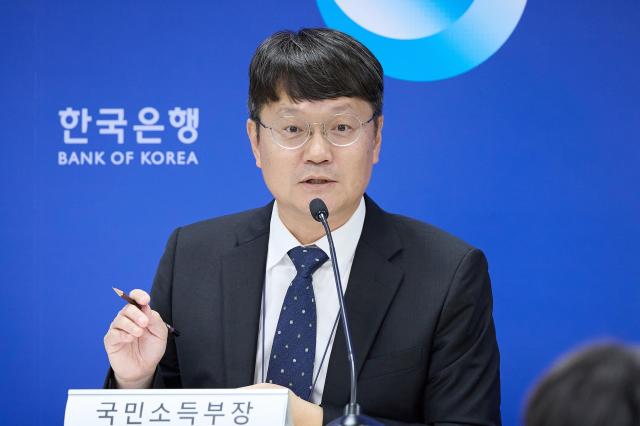
Kim said nominal GNI grew 21.8 percent in the first half and that the likelihood of reaching the milestone had increased significantly.
The 21.8 percent increase was the strongest first-half growth in nominal GNI since 1991, when it rose about 21.9 percent.
Nominal GNI increased 8.8 percent from the previous quarter and 26.4 percent from a year earlier to 846.9 trillion won ($629.2 billion). Nominal GDP rose 9.2 percent from the previous quarter to 834.9 trillion won and was 26.4 percent higher than a year earlier.
The annual increase in nominal GDP was the strongest since the third quarter of 1979, when it rose 27.7 percent.
The unusually large gap between nominal and real growth reflected a sharp rise in prices captured by the GDP deflator.
The GDP deflator climbed 21.9 percent from a year earlier, while the domestic-demand deflator excluding inventories rose 3.6 percent.
The export deflator surged 56.6 percent and the import deflator rose 21.0 percent. The average won-dollar exchange rate was 7.0 percent higher than a year earlier during the quarter.
“The improvement in the terms of trade widened in the second quarter from the first quarter, and we expect the effect to continue,” Kim said.
A stronger won could reduce gains generated through export prices, although lower import prices would offset part of the impact, he said.
Semiconductor prices are also expected to improve in the third and fourth quarters on sustained demand, limiting the overall effect of exchange-rate movements.
Real GDP expanded 0.6 percent from the previous quarter and 3.7 percent from a year earlier, unchanged from the advance estimate released in July.
Manufacturing grew 1.4 percent, led by computer, electronic and optical products. Services expanded 1.0 percent on gains in wholesale and retail trade and accommodation and food services.
Finance and insurance as well as information and communication also increased. Construction contracted 1.9 percent as civil engineering activity declined.
On the expenditure side, private consumption rose 0.4 percent and government consumption increased 0.1 percent.
Construction investment slipped 0.1 percent. Facilities investment edged up 0.2 percent, while intellectual property products investment increased 3.4 percent.
Exports rose 1.3 percent, led by semiconductors and machinery and equipment, while imports gained 0.7 percent.
Kim said improving corporate profitability could support further facilities investment. Non-residential building activity was increasing and the contraction in residential construction was narrowing, leaving room for construction activity to improve.
The improvement was also spreading beyond semiconductors to other manufacturing industries, he said. Stronger consumption could eventually extend the gains to a broader range of industries, although the process would take time.
The gross domestic investment ratio fell to 24.2 percent from 25.3 percent. Nominal gross capital formation, however, increased 4.3 percent during the quarter, meaning the decline in the ratio did not reflect an outright fall in investment.
Kim said domestic investment continued to increase in absolute terms because gross national disposable income grew even faster. Higher corporate income also contributed to increased investment abroad.
The BOK is scheduled to release full-year 2026 per-capita GNI with fourth-quarter national accounts data next March.
AJP Takeaways
- South Korea's real GNI rose 15.6 percent from a year earlier, the fastest increase since the fourth quarter of 1988, as improved terms of trade boosted real purchasing power.
- South Korea's real personal gross disposable income increased 5.5 percent from a year earlier, below the 15.6 percent increase in real GNI.
- South Korea's gross saving ratio reached 45.6 percent, the highest since the series began in 1970. The BOK said higher savings could provide room for future consumption.
- South Korea's chances of reaching $40,000 in per-capita GNI this year increased significantly if the second half avoids a major shock and the won-dollar exchange rate remains stable.

Copyright ⓒ Aju Press All rights reserved.