

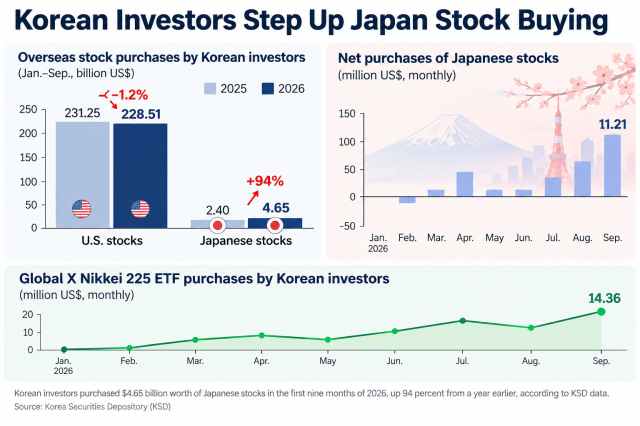
South Korean investors bought $4.65 billion worth of Japanese stocks in the first nine months of 2026, up 94 percent from $2.40 billion a year earlier, according to the Korea Securities Depository (KSD).
Purchases of U.S. shares remained vastly larger at $228.51 billion but fell 1.2 percent over the same period. Wall Street is still the dominant overseas destination for Korean money, though Japan is attracting renewed interest.
For Shin, an investor in his 30s who bought SK hynix at around 2.5 million won, the neighboring market is now on his radar.
“I didn’t have to look as far as Wall Street,” Shin said.
Investors like Shin are known in Korea as “Ilhak ants,” a nickname for retail investors buying Japanese stocks.
The shift became more visible in September, when Korean investors made net purchases of $11.21 million in Japanese stocks. Global X Nikkei 225, an exchange-traded fund tracking Japan’s benchmark index, alone attracted $14.36 million in net buying, according to KSD data.
Four index ETFs among the 50 most-bought Japanese securities drew a combined $18.45 million in net purchases through Sept. 29, compared with $1.72 million across three index funds in August. Among individual stocks, SoftBank Group led with $6.48 million in net buying, followed by trading house Sumitomo Corp. at $2.94 million and chip-testing equipment maker Advantest at $2.73 million.
The appeal rests on several factors: valuations below those of some competing markets, a currency that remains weak despite rising interest rates, and companies supplying the global AI investment boom.
Yuji Hosaka, a specially appointed professor at Korea University’s Graduate School of Public Administration, said Japan presents an unusual combination of higher rates and resilient equities.
“The conventional pattern is not playing out in the same way in Japan,” Hosaka said. “Rates are moving up gradually, but the yen remains weak.”
That leaves room for investors to benefit from exporters’ currency advantage and, potentially, a gradual yen recovery, he said.
Valuations offer an opening
Japanese stocks are not uniformly cheap, but their valuations offer an opening for investors wary of the sharp gains in Korean and U.S. technology shares.
The MSCI Japan Index traded at 16.38 times expected earnings as of Aug. 31. Its price-to-book ratio, which compares share prices with net asset values, stood at 2.03.
An analyst specializing in the Japanese market told AJP that earlier underperformance had left parts of the market better positioned to benefit from improving semiconductor sentiment.
“Japan had lagged other markets, so valuations still looked relatively attractive as semiconductor sentiment improved,” the analyst said.
The weak yen also lowers the currency cost of entering the market, although Korean investors’ eventual returns depend on its movement against the won.
Japan’s interest rates remain relatively low despite successive increases. The Bank of Japan raised its policy rate by 0.25 percentage point to 1.25 percent in September, its highest level in 31 years. Borrowing costs have risen, but funding conditions remain relatively supportive of corporate investment.
Corporate-governance reforms provide another source of optimism.
Japanese regulators and the Tokyo Stock Exchange have pressed listed companies to use capital more efficiently and improve corporate value. A July revision of the Corporate Governance Code placed greater emphasis on investment for growth and stronger board oversight.
“The government and market authorities are pushing companies to improve corporate governance and corporate value,” Hosaka said. “That creates an expectation that companies will have to improve the way they are managed.”
An alternative route into AI
Japan’s semiconductor supply chain gives investors exposure to the same data-center spending that has lifted earnings expectations for U.S., Korean and Taiwanese chipmakers.
Its companies supply the materials, components and equipment needed to manufacture and test increasingly sophisticated chips.
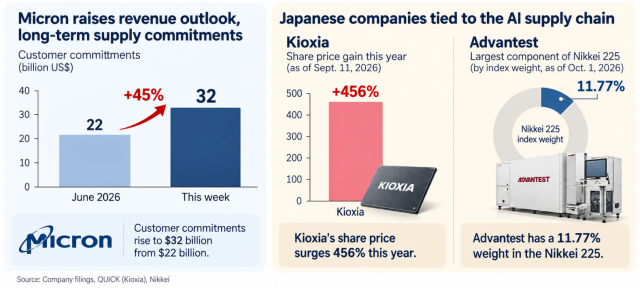
Micron Technology this week forecast quarterly revenue above market estimates and said customer commitments under long-term supply agreements had risen to $32 billion from $22 billion in June, underscoring sustained demand for AI memory and data-center capacity.
Japanese shares exposed to that spending have already made substantial gains. Memory-chip maker Kioxia had surged 456 percent this year as of Sept. 11. Advantest was the largest constituent of the Nikkei 225 by index weight as of Thursday, accounting for 11.77 percent.
“The AI market itself is led by the United States, but Japanese semiconductor and equipment companies are moving with the same cycle,” the analyst said. “I see it as part of the broader semiconductor upturn.”
Japan’s established robotics and factory-automation industries offer another route into that investment cycle. The country remained Asia’s second-largest industrial robot market in 2025, according to the International Federation of Robotics.
The strength in manufacturing is also showing up in business confidence. The BOJ’s Tankan survey put sentiment among large manufacturers at plus 24 in the July–September quarter, its strongest reading since March 2018. Global AI demand supported manufacturers even as confidence among non-manufacturers weakened.
For Korean investors, Hosaka said, some of Japan’s more established opportunities lie in the businesses surrounding chip production.
“Japan’s materials, components and equipment suppliers should remain strong,” he said. “Those businesses are benefiting from the semiconductor boom.”
The yen’s double edge
The yen has remained weak despite monetary tightening, falling as far as 158.05 per dollar after the September rate increase. That boosts the yen value of overseas earnings for Japan’s exporters.
A moderate currency recovery would not necessarily erase that advantage, the analyst said.
“Even if the yen rebounds, it is still starting from a very weak level,” the analyst said. “Unless it suddenly strengthens to around 125 per dollar, a moderate recovery would not automatically put Japanese exporters at a disadvantage.”
The Nikkei 225 stood at 68,189.94 on Friday, down 1.11 percent from Thursday’s record close of 68,956.72 but still about 3 percent above its Sept. 1 opening level.
The question is how well the market can absorb further rate increases.
Tokyo core consumer prices rose 2.7 percent in September from a year earlier, accelerating from 1.8 percent in August. A separate measure excluding fresh food and fuel climbed 3 percent, adding to pressure for further tightening.
Several BOJ policymakers said at the September meeting that rates might need to rise faster if underlying inflation strengthened. Government representatives urged the central bank to assess the cumulative impact of earlier increases before moving too aggressively.
For Korean investors, a stronger yen could add to returns when converted into won. But a sharp appreciation could squeeze exporters’ earnings, while higher borrowing costs could weigh on investment and stock valuations.
Hosaka said gradual tightening alone was unlikely to derail the market.
“Even with further rate increases, I do not think they will become a major long-term problem for Japanese stocks,” he said.

Copyright ⓒ Aju Press All rights reserved.
