
ZURICH, November 12 (AJP) -Europe may not be leading the talks to end the war in Ukraine, but it is paying for much of the war effort — making its money its main source of influence over any peace deal and the focus of a budget fight this week.
Since the United States sharply cut its aid, European countries have become Ukraine’s largest military donors, according to the Kiel Institute for the World Economy, a German research group tracking support for Ukraine.
European governments committed nearly 11 billion euros ($12.2 billion) in May and June alone, most of it through a 90 billion euro EU loan covering Ukraine’s budget and defense needs in 2026 and 2027.
That funding matters at the negotiating table.
Ukraine faces a funding gap of about 70 billion euros next year, and the EU has promised to cover about 45 billion euros, or 64 percent of the shortage.
The latest round of talks between Russia, Ukraine and the United States ended in Abu Dhabi on Wednesday with an agreement in principle on a large prisoner exchange but no breakthrough on territory. European officials were present, but Russia’s chief negotiator Vladimir Medinsky said his delegation did not engage with them.
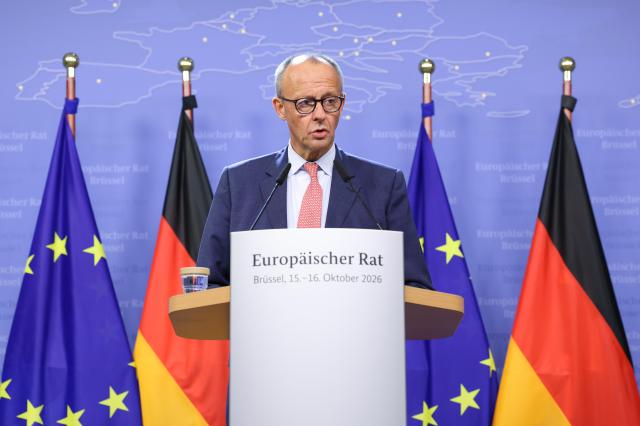
Europe’s financial leverage is being tested at home. On Monday, German Chancellor Friedrich Merz threatened to block the EU’s next seven-year budget unless all 27 member states commit to funding Ukraine. Both decisions require unanimous approval.
Four countries pushed back. Slovak Prime Minister Robert Fico called the move “a textbook case of blackmail” and threatened to use his veto. Czechia and Hungary, which also stayed out of the 90 billion euro loan, rejected the link as well. Bulgaria cited its high deficit.
Hungarian Prime Minister Péter Magyar struck a more conciliatory tone, however. “I do not consider this to be blackmail,” he said, adding that he expected a solution would be found.
Economy Commissioner Valdis Dombrovskis said Ukraine’s funding should be backed “by the EU27, not by the EU24 or any number of countries.”
Europe’s money also has limits on the battlefield. It still depends on American weapons, especially Patriot air defense systems, for which there are few European alternatives, the Kiel Institute said. European governments bought at least 3 billion euros of weapons from U.S. companies for Ukraine in the first half of this year.
Security guarantees offer another potential source of influence. A group of European countries known as the “coalition of the willing” has been preparing a possible force to help secure Ukraine after a ceasefire. U.S. envoy Jared Kushner said the talks had made “significant progress” on guarantees, but no details were released.
A ceasefire would bring another substantial bill: rebuilding Ukraine. Europe expects to carry much of that cost, with countries outside the EU also pledging support.
Switzerland has committed 5 billion Swiss francs to Ukraine’s recovery through 2036. It also hosted the first international conference on rebuilding Ukraine in Lugano in 2022.
Asian allies are contributing too. Japan plans to provide about 6 billion dollars in humanitarian and economic support to Ukraine this year, Ukrainian President Volodymyr Zelenskyy said.
South Korea’s role is smaller but growing. President Lee Jae Myung pledged 100 million dollars in aid at a NATO summit in July, and the government has set aside another 100 million dollars for Ukraine in its 2027 draft budget.
EU leaders are due to return to the budget fight at a special summit on Nov. 26 and 27. Whether Europe can agree on paying for Ukraine may say more about its influence over a peace deal than any seat at the negotiating table.
Tags: Ukraine, Russia, European Union, Abu Dhabi talks, Friedrich Merz, Robert Fico, Péter Magyar, Valdis Dombrovskis, Jared Kushner, Vladimir Medinsky, Kiel Institute, coalition of the willing, EU budget, Switzerland, Japan, South Korea, Lee Jae Myung, North Korea, Volodymyr Zelenskyy
Copyright ⓒ Aju Press All rights reserved.


