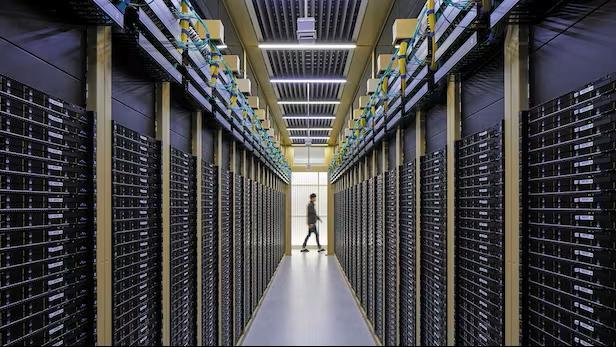
SEOUL, November 13 (AJP) — For all the attention paid to chips, an AI data center is mostly a machine for moving electricity in and heat out. Before a watt reaches a GPU, it passes through a power plant, transmission lines and transformers, with batteries helping stabilize supply and provide backup.
It then leaves as heat that has to be pumped, chilled or carried off by water. South Korea makes much of the equipment along that path, so the AI boom has paid the country well beyond its memory chipmakers.
Huang's departure adds uncertainty to the pace of that buildout. But the equipment surrounding the chips runs on longer investment cycles, and much of it serves electricity networks whose needs extend beyond AI.
The early hype and building spree are already running into constraints.
In early November, Morgan Stanley said it expected about 5 gigawatts, or 20 percent, of the U.S. data center capacity planned for 2028 to slip into 2029. Research firm BMI estimates that 53 percent of U.S. hyperscale pipeline growth is exposed to slowdown risk, though "construction schedules for 2027 are largely locked in."
Korea plans 8.4 gigawatts (GW) of AI data center capacity by 2029 and 18.4 GW by 2035. Only about 2.5 GW of roughly 20 GW announced has confirmed demand, according to a Sept. 2 issue brief by NEXT, a Seoul-based climate and energy think tank.
Heat
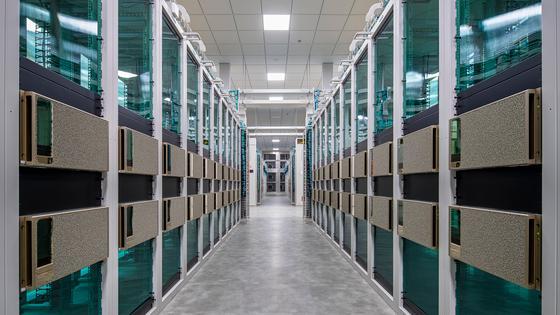
A conventional server rack draws 5 to 10 kilowatts, while racks packed with AI chips draw 40 to 100 kW or more. Cooling accounts for about 7 percent of electricity consumption at an efficient hyperscale site and more than 30 percent at less efficient enterprise sites, according to the International Energy Agency (IEA).
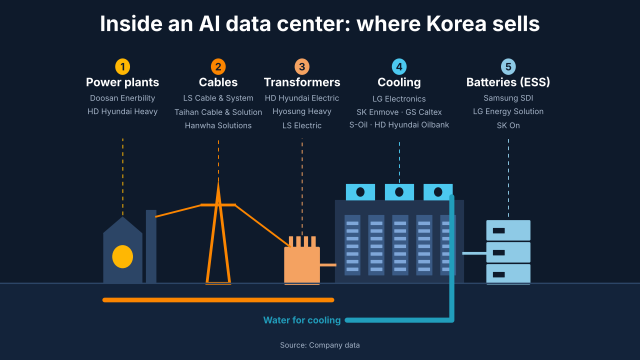
In July, LG Electronics became the first Korean company to win Nvidia's validation for a coolant distribution unit, which circulates coolant through liquid-cooling systems. A 2023 SK Telecom test that submerged servers in fluid cut cooling power consumption by 93 percent.
Oil refiners are developing cooling fluids, and shipbuilders are designing floating data centers cooled by seawater. Much of this emerging business remains in validation or pilot stages.
Cooling also brings noise. In April, Microsoft acknowledged that a hum from cooling fans at its Fairwater campus in Wisconsin carried farther than expected. Neighbors sued in July.
The site
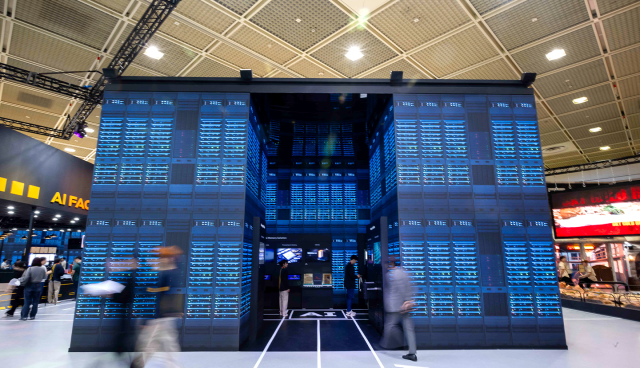
SK Group and Amazon Web Services (AWS) broke ground in Ulsan in August 2025, with SK Ecoplant building the first hall under a 416.9 billion won contract.
The site's initial 41 megawatts (MW) are due by November 2027, rising to 103 MW with about 60,000 GPUs by February 2029. SK Group Chairman Chey Tae-won said in September that expansion plans were nearing 900 MW.
Electricity access helps determine where that can happen.
Of 736 applications for grid impact reviews of planned data centers filed between August 2024 and March 2026, 71 percent came from the capital area, according to climate ministry data.
Only 10 capital-area projects totaling about 1 GW won final approval out of 33.6 GW sought. Outside the capital area, 187 of 214 applications cleared the first review.
"Saying data centers can't be built for lack of power is a misunderstanding," said Kim Chul-hyun, a senior research fellow at the Korea Energy Economics Institute.
"It's merely the grid to the capital area that is saturated."
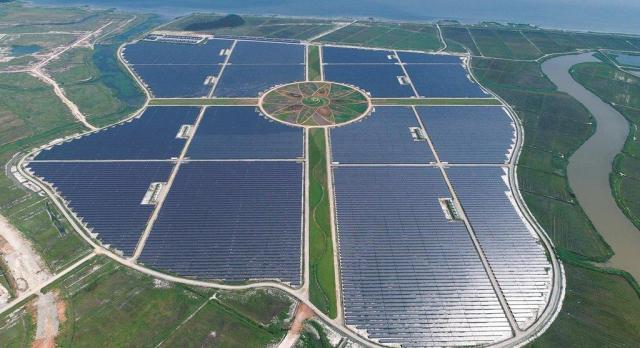
Honam, the southwestern region that hosts much of Korea's solar capacity, already generates more electricity than it uses, with a surplus of about 3 to 5 GW, the climate ministry said in July.
On the east coast, power plants had 17.4 GW of generating capacity last year, but transmission lines out of the region could carry only 11.6 GW.
The high-voltage direct current (HVDC) link intended to close that gap was originally due in 2019. It is now scheduled for 2027 after years of local opposition along its route and to an expanded converter station in Hanam, east of Seoul.
Seoul itself generates only about a tenth of the electricity it uses.
Elsewhere, the strain is already prompting restrictions and resistance.
Data centers used 23 percent of Ireland's metered electricity in 2025. Malaysia has restricted new data centers unrelated to AI for nearly two years. In the United States, local opposition blocked or delayed at least 45 projects worth nearly 68 billion dollars in the second quarter, according to Data Center Watch.
Power generation
Korea secured the world's first standard design approval for a small modular reactor (SMR) in 2012 but has yet to put one into operation. Its homegrown i-SMR is not due for completion until 2035.
"There was not enough electricity, so the big tech firms decided to make it themselves," said Chung Bum-jin, a professor of nuclear engineering at Kyung Hee University, describing data center developers.
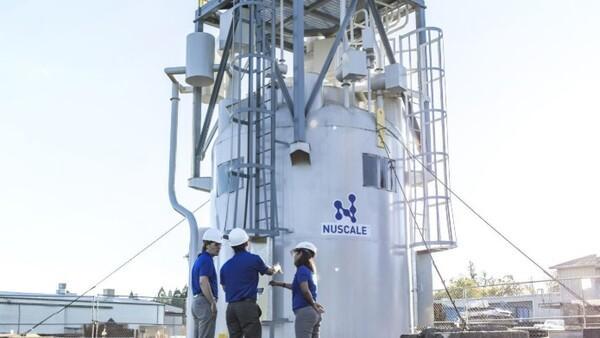
In January 2026, Meta agreed to fund two of TerraPower's Natrium reactors totaling up to 690 MW, with delivery as early as 2032. The agreement also included rights to power from up to six more units by 2035.
What developers need, Chung said, is "24/7 firm power" — electricity reliably available around the clock.
Doosan Enerbility, which already makes SMR components for American developers, is building a plant in Changwon with annual manufacturing capacity for about 20 SMRs by 2031.
"We are a company that takes the design once it is set and manufactures it," said Song Yong-ho, a senior manager at Doosan Enerbility. "We are simply waiting on KHNP to give their blue print for the nation's first SMR."
HD Hyundai Heavy Industries signed a framework agreement in May to supply reactors for TerraPower's Natrium plant.
Gas turbines are already shipping.
On Oct. 6, Doosan dispatched its first exported 380-MW gas turbine, bound for SpaceXAI, Elon Musk's AI company, which has ordered 12.
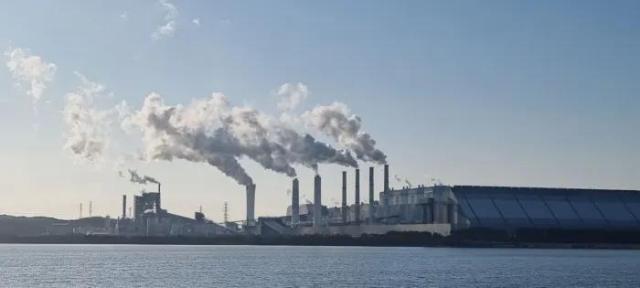
"There are many coal plants sitting idle," he said. "We can use those."
He treated the emissions implications as a separate question.
Batteries
Synchronized GPU training can cause a hyperscale site's power demand to swing by tens of megawatts within milliseconds, according to energy research firm E Source. Batteries help absorb those fluctuations.
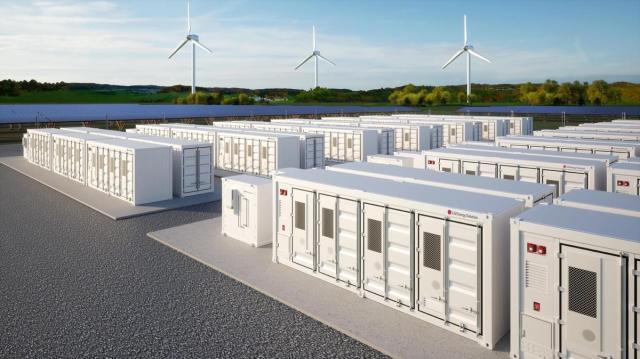
Washington's tariffs widen the opening. The United States charges 40.9 percent on Chinese lithium-ion batteries against 12.5 percent on Korean ones. Chinese competition nevertheless remains formidable: CATL alone accounted for 27.1 percent of global energy storage battery shipments in the first half.
At home, Samsung SDI and SK On are competing to supply batteries for the government's third energy storage auction.
At 1,180 MW, the round is larger than the first two combined. The Korea Power Exchange is expected to name preferred bidders in November.
The wires
Lead times for generator step-up transformers, which raise voltage for transmission, exceeded 160 weeks in the first quarter of 2026, up from 143 weeks in 2024, according to Wood Mackenzie data.
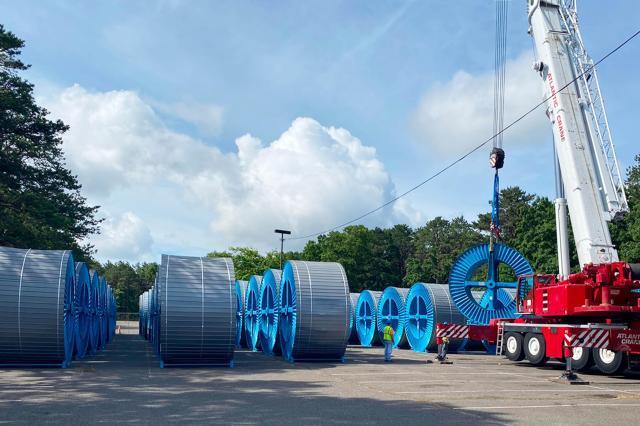
LS Electric's third-quarter operating profit more than doubled, while HD Hyundai Electric's rose 15.1 percent and Hyosung Heavy Industries' increased 10.8 percent. Hyosung's heavy industries backlog reached a record 18.9 trillion won.
HD Hyundai Electric expects a package order from a major technology company to help roughly double its distribution transformer sales next year to about 300 billion won.
Cable makers are on the same curve.
Taihan Cable & Solution's backlog reached a record 4.3 trillion won at the end of September. LS Cable & System's stood at 9.6 trillion won at the end of June.
Korea's planned west coast "energy highway," an HVDC line linking the southwest to the Seoul area, will require the same types of cables and converters.
After the lull
A pause in construction would put builders and equipment for new halls under pressure first. Long order books offer transformer, cable and battery suppliers a cushion, while grid upgrades provide demand beyond data centers alone.
Morgan Stanley expects a shortfall of more than 30 percent in powered U.S. data center capacity to persist through 2028. Goldman Sachs expects global data center power demand to rise 170 percent between 2025 and 2030.
The forecasts point to continuing infrastructure needs, but they do not guarantee customers for every proposed hall.
SK Telecom plans to operate much of its new capacity as AI colocation, leasing space and power to tenants.
"A colocation data center is, in the end, a high-end PC bang for tech firms with all the brand-new games on them," Kim said, referring to Korea’s internet gaming cafes. "How much demand there will be, nobody knows."
Chung sees the slowdown as a question of pace.
"Faster or slower, it is a future that is certain to come," he said.
The Ulsan hall is due to reach full load in 2029. By then, the GPUs in its first rows may be a generation old.
The transformers, cables and batteries around them were bought to outlast several chip generations. Korea's other AI dividend therefore has a different lifespan from its chip windfall, supported partly by the wider need to reinforce electricity networks.
How far it grows will still depend on how many halls on paper get built — and how many find tenants.
Chung put it more simply. "Someone who has used a computer can't stop using one," he said. "The same goes for a phone, and AI."
Copyright ⓒ Aju Press All rights reserved.