SEOUL, July 30 (AJP) - A trophy child often comes at the expense of a sibling, and the "beggar-thy-family" concept can scarcely be better illustrated than by Samsung Electronics' second-quarter results.
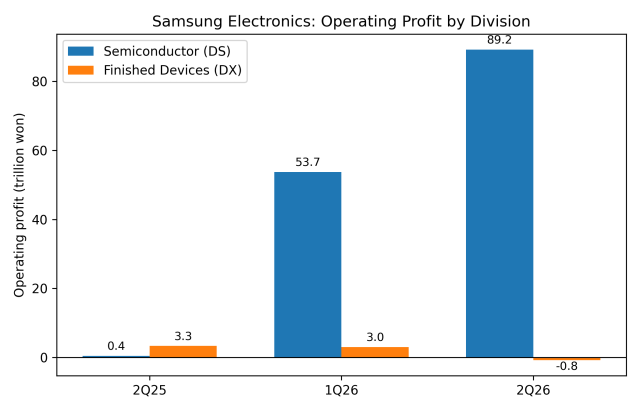
The South Korean technology behemoth reported that its Device Solutions (DS) semiconductor division generated an operating profit of 89.2 trillion won ($64.4 billion) on revenue of 127.5 trillion won in the second quarter, translating into a jaw-dropping operating margin of 70.0 percent — a level that has become increasingly familiar among AI memory titans.
The bottom line was virtually identical to Samsung's companywide operating profit of 89.5 trillion won on record revenue of 171.5 trillion won, underscoring how the chip division effectively generated the group's entire earnings.
The bulky quarterly profit, which eclipsed Samsung's full-year 2025 operating income, more than offset losses in businesses that once made the company a household name.
The Mobile eXperience (MX) division, responsible for smartphones, posted a 700 billion won operating loss as soaring memory prices sharply inflated component costs.
The culprit was the same force powering the semiconductor bonanza: artificial intelligence.
Explosive investment in AI infrastructure has deepened memory shortages and driven prices to unprecedented highs.
Memory chips, which traditionally accounted for just 10 to 15 percent of a smartphone's bill of materials, have recently approached half the production cost of premium AI-enabled devices.
With consumer demand still subdued, Samsung has been unable to pass those higher costs fully onto buyers, forcing its smartphone business to absorb the squeeze.
Just as semiconductors have become the overwhelming driver of Korean exports while much of the manufacturing sector struggles with sluggish global demand, geopolitical risks and intensifying Chinese competition, Samsung's semiconductor division has become powerful enough to mask deterioration across much of the rest of the company.
The earnings also explain why Samsung is preparing for a future in which AI extends well beyond semiconductors.
In its latest organizational reshuffle, the company placed its robotics business directly under Chairman Jay Y. Lee, reflecting its ambition to accelerate AI transformation and position robotics as the group's next strategic growth engine.
More importantly, Samsung believes the current memory upcycle will last far longer than the industry's traditional one- to two-year boom-and-bust pattern.
During its earnings conference call, the company said explosive growth in AI infrastructure, agentic AI and sovereign AI projects is expected to keep demand outpacing industry supply through at least 2028 despite aggressive capacity expansion across the semiconductor sector.
"We expect the supply-demand imbalance in AI memory to continue through at least 2028," Samsung said, noting that the years required to build new fabrication plants and expand advanced packaging capacity would prevent the industry from responding quickly to surging demand.
The company also disclosed that customers are increasingly seeking multi-year supply agreements and making advance payments to secure memory capacity, reflecting what it described as a structural shift in the memory market.
Samsung said it has already completed long-term agreements with five global hyperscale data-center customers and is in the final stages of negotiations with another five major AI-related clients.
"As time passes, the number of customers signing multi-year supply contracts will continue to increase," the company said. "Once ongoing negotiations are completed, multi-year agreements should be sufficient to cover 60 to 70 percent of our planned medium-term production capacity."
If realized, the shift could fundamentally alter one of the semiconductor industry's defining characteristics.
For decades, memory chips have been synonymous with violent boom-and-bust cycles as periods of tight supply inevitably gave way to oversupply and collapsing prices. Long-term supply contracts and structurally constrained capacity could instead make elevated memory prices a lasting feature of the AI era rather than a temporary spike.
That would strengthen the earnings visibility of Samsung Electronics and SK hynix while raising costs across the broader technology industry, from cloud-service providers to AI chip designers and consumer electronics manufacturers.
Samsung expects shipments of next-generation HBM4 memory to expand significantly in the second half of the year while further strengthening its leadership in AI memory. It also said its foundry business is improving as demand rises for advanced process technologies and HBM base dies.
Samsung's latest earnings therefore tell a story far larger than one record-breaking quarter.
They illustrate an increasingly polarized economy in which one extraordinary winner carries the family while the rest struggle to keep pace — a corporate portrait of South Korea's emerging beggar-thy-family era.

Copyright ⓒ Aju Press All rights reserved.