SEOUL, July 31 (AJP) - Red-hot chip demand, which earned South Korea's two chipmakers 150 trillion won ($108 billion) in combined second-quarter operating profit — equivalent to about 6 percent of the country's entire 2025 nominal GDP — is beginning to warm the broader domestic front, with the AI boom spilling from exports into factories, construction sites and household spending.
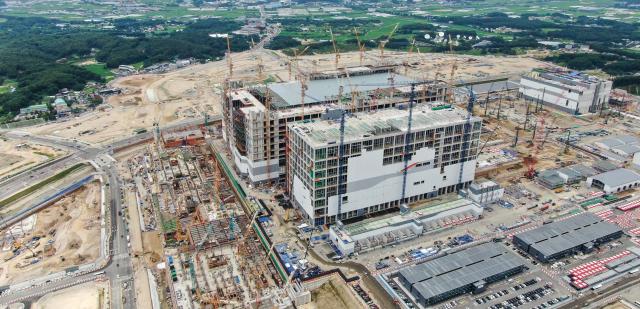
The latest government data suggest the country's semiconductor-driven expansion is no longer confined to export earnings. It is increasingly feeding capital investment, machinery orders and consumer activity as chipmakers embark on one of the world's largest manufacturing buildouts.
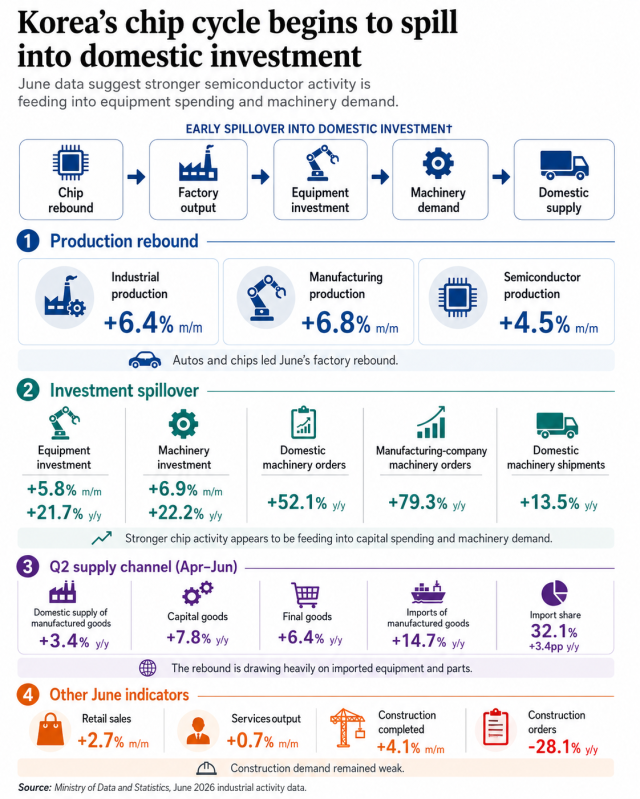
Industrial production rose 6.4 percent from May in June, reversing a 2.9 percent decline the previous month, according to the Ministry of Data and Statistics Friday.
Manufacturing output climbed 6.8 percent from May, led by automobiles and semiconductors. Semiconductor production rose 4.5 percent as output of DRAM and NAND flash memory chips increased, while automobile production jumped 15.4 percent, pointing to a broadening industrial recovery.
The strongest spillover appeared in corporate investment.
Facility investment rose 5.8 percent from May and 21.7 percent from a year earlier as semiconductor companies accelerated capacity expansion to meet resilient global AI demand.
Machinery investment increased 6.9 percent on the month and 22.2 percent from a year earlier, with semiconductor manufacturing equipment accounting for much of the annual gain.
Domestic machinery orders, excluding ships, surged 52.1 percent from a year earlier in June, accelerating from a 24.0 percent increase in May. Private-sector orders climbed 56.5 percent, while manufacturing companies boosted orders 79.3 percent, underscoring the strength of the semiconductor investment cycle.
Domestic machinery shipments also rose 13.5 percent from a year earlier, reinforcing signs that equipment demand within South Korea continued to strengthen.
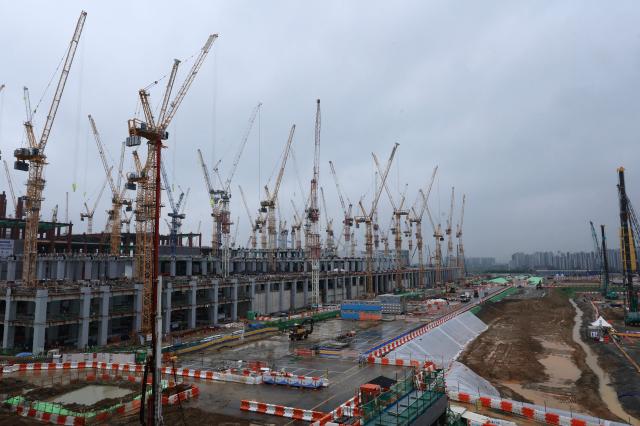
Samsung Electronics has outlined 2,450 trillion won ($1.6 trillion) in domestic investment through 2040, including 2,100 trillion won across its Pyeongtaek and Yongin semiconductor clusters, 400 trillion won for fabs in Gwangju and 56 trillion won for high-bandwidth memory facilities in Cheonan and Onyang.
SK hynix has announced a separate 1,100 trillion won investment framework, allocating 600 trillion won to Yongin, 100 trillion won to Cheongju and 400 trillion won to southwestern South Korea.
Together, Samsung plans six new fabrication plants and SK hynix four, with completion schedules brought forward to 2033 from the original 2045 roadmap. SK hynix's first new fab could begin operations as early as next year. Each advanced fab is estimated to cost roughly $30 billion.
Imports of manufactured goods rose 14.7 percent from a year earlier in the second quarter, while domestically produced manufactured supply fell 1.2 percent, lifting the import share of manufactured goods by 3.4 percentage points to 32.1 percent.
The increase reflects growing imports of advanced semiconductor equipment and specialized components needed for AI-related capacity expansion.
Broader indicators also pointed to improving domestic demand.
Retail sales rose 2.7 percent from May, the strongest gain in five months, driven by higher purchases of passenger vehicles, communications devices and computers.
Services output increased 0.7 percent, while construction completed rose 4.1 percent from the previous month.
The recovery, however, remains uneven. Construction orders fell 28.1 percent from a year earlier in June, while construction completed remained 4.0 percent below year-earlier levels despite the monthly rebound.
Copyright ⓒ Aju Press All rights reserved.